Strategy 03 · Intraday Futures Trading
A daily futures strategy across 12 global markets — machine learning signals, dynamic market regime classification, rigorous risk management, and zero overnight exposure.
Risk Architecture
Before any trade is placed, the market regime is classified. Each regime triggers a distinct allocation rule — ensuring the strategy only takes risk when conditions are structurally favourable.
Academic Foundation
Every design decision in Magic Trader traces back to published finance research — from regime theory to machine learning for financial time series.
01 · Regime Detection
Regime-switching in financial markets is a well-established phenomenon. The strategy classifies the prevailing market environment each day before any trade is considered — ensuring capital is deployed only when conditions are structurally favourable.
02 · Machine Learning
Gradient-boosted tree models have consistently demonstrated strong performance on tabular financial data. The model is retrained regularly to adapt to shifting market dynamics, with recent data weighted more heavily to reflect current conditions.
03 · Intraday Edge
A systematic and persistent difference between open and close prices in futures markets has been documented in academic literature. The strategy is designed to capture this structural edge while carrying zero overnight risk.
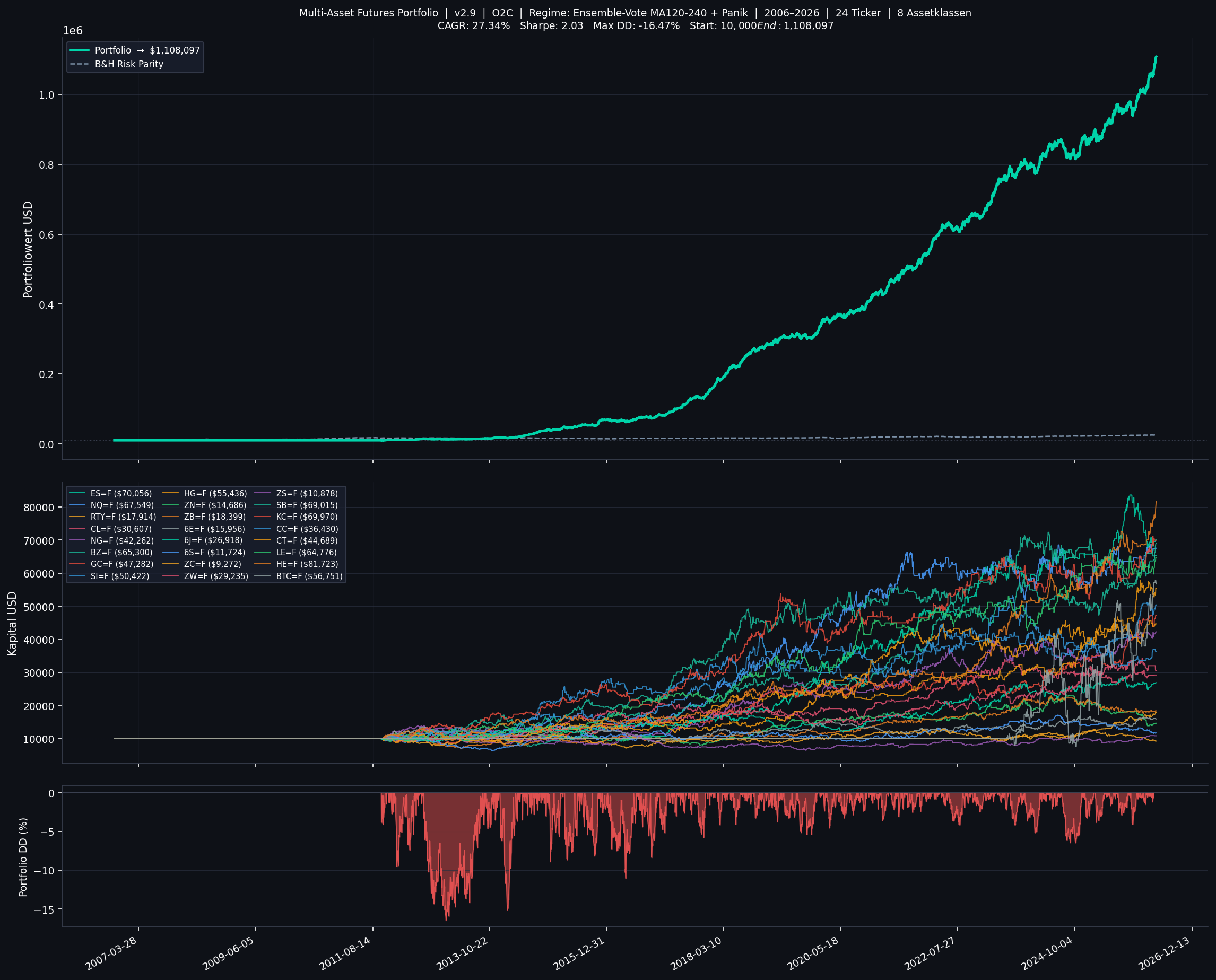
Backtest Performance · 2006 – 2026
12 global futures markets · Benchmark: ES=F
Equity Curve
* Actual backtest results. Past performance is not indicative of future results. All figures are gross of taxes and transaction costs.
Process
After market close, price data is collected for all 12 futures markets. Over 120 quantitative features are derived from this data. The machine learning model processes these features and produces a directional signal — long or short — for each market the following day.
Each day, the prevailing market environment is classified into one of four regimes. Depending on the regime, trades are either enabled, restricted, or suspended entirely. This layer ensures the strategy only operates under structurally favourable conditions.
Each trade is sized according to a rigorous risk budgeting framework that accounts for the volatility of the individual instrument and the aggregate portfolio. The total portfolio exposure is continuously calibrated to a defined risk target, with additional filters to avoid abnormal market conditions.
Entry and exit orders are placed fully automatically before the market open each morning. The entire execution pipeline — from signal to order submission — runs without manual intervention, ensuring consistent and disciplined trade execution.
At the start of each month, the machine learning model is retrained on all available historical data. The feature selection process is refreshed and model parameters are re-optimised — allowing the strategy to adapt to evolving market dynamics while maintaining out-of-sample discipline.