Strategy 01 · Long-Term Investing
A systematic, machine learning–driven portfolio that rebalances monthly — selecting the strongest assets from a diversified universe based on objective signals, without emotion and with strict risk controls.
Academic Foundation
The Smart Investor strategy is grounded in well-documented academic phenomena — each principle backed by decades of empirical research across global markets.
01 · Momentum
Assets that have outperformed their peers over recent months tend to continue doing so — a persistent anomaly documented across global markets for decades. The strategy ranks assets each month and allocates to the strongest.
02 · Factor Investing
Systematic risk factors — including momentum, trend, and volatility — have been shown to explain persistent return differences across asset classes. A broad set of such factors forms the foundation of the signal generation process.
03 · Risk Parity
Position sizes are adjusted according to each asset's risk contribution, ensuring that no single holding dominates the portfolio's risk profile — regardless of its expected return.
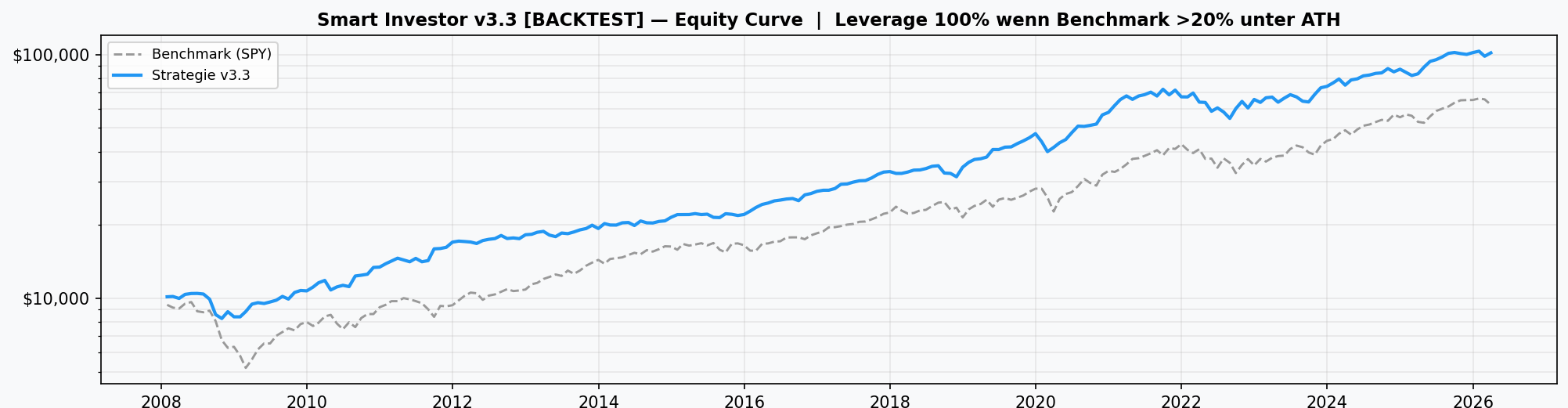
Backtest Performance · 2005 – 2026
Multi-asset universe · Benchmark: SPY
Equity Curve
* Actual backtest results. Past performance is not indicative of future results. All figures are gross of taxes and transaction costs.
Process
Price and market data is collected monthly for all assets in the universe. A comprehensive set of quantitative features is derived — covering momentum, trend, volatility, volume, and broader market structure — providing a multi-dimensional view of each asset.
All features are normalised and ranked cross-sectionally within the universe. This ensures comparability across assets and time periods, and prevents any single metric from dominating the signal — without introducing any look-ahead bias.
A systematic selection process identifies the most predictive and non-redundant features for the current market environment. Only robust, uncorrelated signals are retained — keeping the model lean and resistant to overfitting.
A machine learning classifier is trained strictly on historical data preceding each signal date. It produces a ranking of all assets — from which the top performers are selected for the coming month's portfolio.
Each selected asset receives a position sized according to its risk contribution to the overall portfolio. Positions are rebalanced systematically at month-end, with orders executed automatically at closing prices.