Strategy 02 · Market-Neutral Equity

Absolute Return

A fully automated long/short strategy across the S&P 500 — systematically capturing both upward and downward momentum while remaining independent of the market's overall direction.


Two sides.
One objective.

The strategy identifies the strongest and weakest stocks in the S&P 500 at each rebalancing date. The long side captures upward momentum; the short side profits from underperformance. Together, they form a market-neutral book.

Long Side Highest-ranked stocks by predicted upside probability.
Weighted by risk contribution.
Short Side Lowest-ranked stocks by predicted upside probability.
Weighted by risk contribution.

Built on decades of
financial research.

Every design decision traces back to well-established academic research — from market-neutral portfolio theory to behavioural finance and risk parity.

01 · Market Neutrality

Long/Short Equity

A balanced long/short construction removes systematic market exposure (beta), allowing the strategy to generate returns independent of broad market direction. Capital is split equally between the long and short side at all times.

02 · Momentum & Reversal

Cross-Sectional Signals

Relative strength and momentum across individual stocks are among the most robust and persistent anomalies documented in academic finance. The strategy exploits these patterns across the full S&P 500 universe at every rebalancing date.

03 · Risk Parity

Volatility-Adjusted Sizing

Within each side of the book, positions are sized according to each stock's risk contribution rather than its expected return. This equalises risk exposure across all holdings and prevents any single position from dominating the portfolio's behaviour.

25 years. Market-independent returns.

S&P 500 universe · Benchmark: SPY · Weekly rebalancing

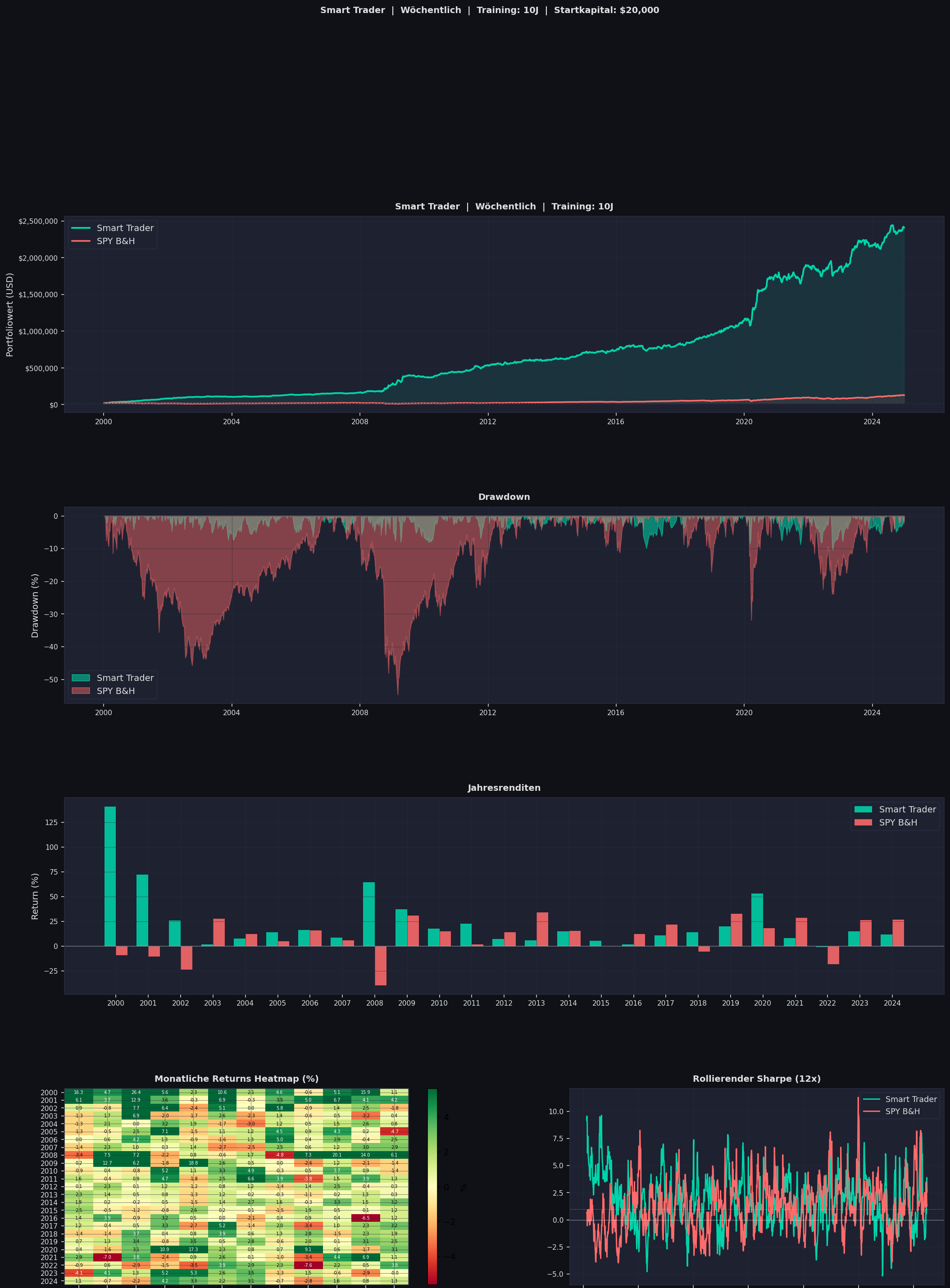
+21.07%
CAGR
1.77
Sharpe Ratio
−10.39%
Max Drawdown
+13.38%
Alpha vs SPY
2.03
Calmar Ratio
60.5%
Positive Weeks

Strategy vs Benchmark

Strategy +21.07% p.a.
SPY +11.1% p.a.
Period 2000 – 2024
Absolute Return – Equity Curve & Drawdown

* Actual backtest results. Past performance is not indicative of future results. All figures are gross of taxes and transaction costs.

How the strategy
works.

01

Data Collection & Feature Engineering

Price data for all S&P 500 stocks is collected at each rebalancing date. A set of quantitative features is computed for every stock — capturing short- and medium-term price dynamics, volatility characteristics, and relative market behaviour. Features scale automatically with the chosen rebalancing frequency.

02

Normalisation & Cross-Sectional Ranking

All features are normalised using rolling historical windows to ensure comparability across stocks and over time. Each stock then receives a cross-sectional rank within the full universe — from the most to the least attractive — without any reference to future data.

03

Signal Generation

A machine learning model — trained strictly on historical data preceding each rebalancing date — assigns each stock a probability score reflecting its expected return over the coming period. The model is retrained on a rolling basis to adapt to changing market dynamics.

04

Portfolio Construction

The highest-scoring stocks form the long book; the lowest-scoring stocks form the short book. Capital is allocated equally between the two sides, resulting in a market-neutral portfolio with balanced long and short exposure at all times.

05

Position Sizing & Rebalancing

Within each side, positions are sized according to their individual risk contribution — lower-volatility stocks receive proportionally larger allocations. The portfolio is rebalanced systematically at a configurable frequency, with orders executed automatically at the close of each rebalancing date.